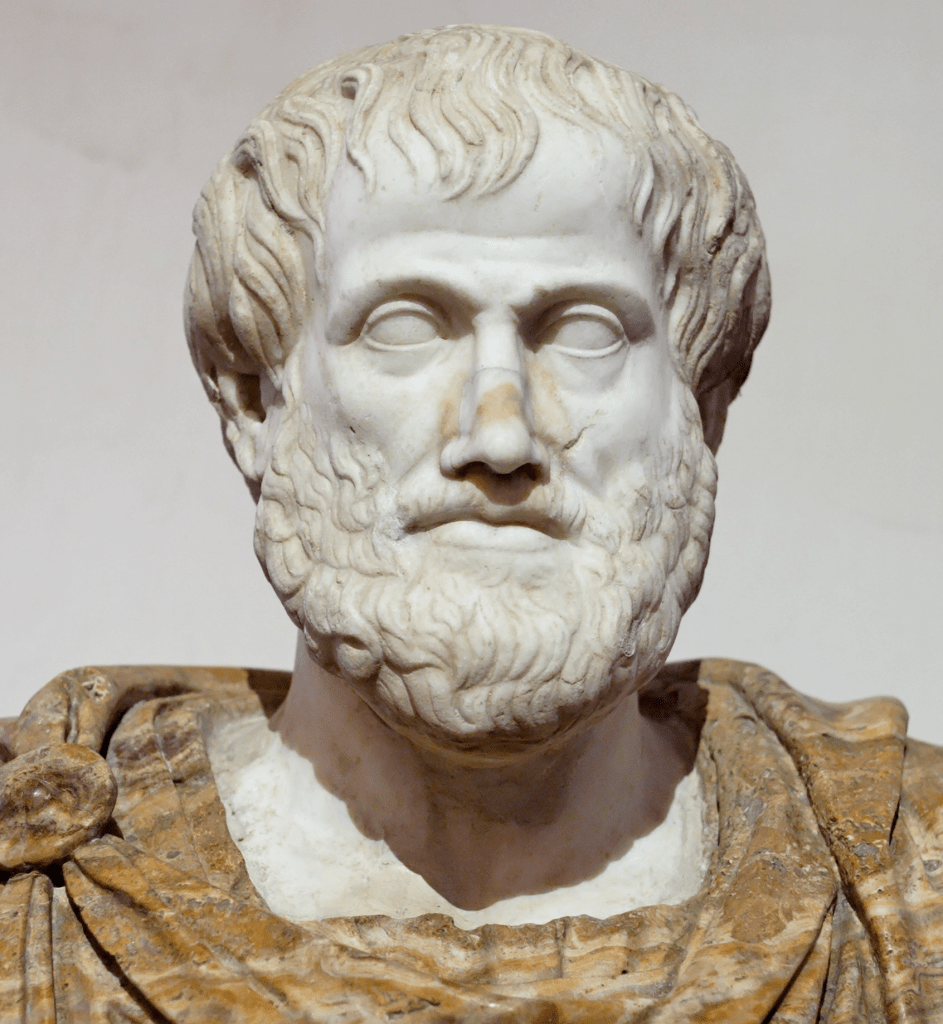
Aristotle’s Nicomachean Ethics can be outlined, as Aristotle himself states in the text, “the excellences, the forms of friendship, the varieties of pleasure… [and] the nature of happiness.” (Aristotle, Nicomachean Ethics, The Complete Works of Aristotle, Volume Two Princeton University Press, 1984. Page 1854.) This is a book not only on moral theory, but one which provides the best system of justification for an ethical theory aside from that of divine revelation, and indeed, the Christian idea of the beatific vision fits well with Aristotle, for they both give a teleological cause for ethics. They both seek to answer the right question, what is the end of man?
What is the end (the word “end” here is used as purpose or reason for being) of man? To Aristotle man’s end is happiness, and the means of being happy is defined as activity in excellence. This is the good, to which all men aim, for all desire happiness. He uses the term happiness in a way very different from how it is commonly used today. He is not saying that the transitory positive feelings that come and go are the happiness which is the end of human activity; rather happiness is the outcome of proper activity which results in living and faring well (page 1753). All men aim for this, but not all aim well, for passions and even wickedness can cloud the vision, causing incontinence to overthrow reason; a habitual pattern of which ends in a vicious person. Why is happiness an end and what does it mean that all aim for it? Simply this, there are things that are done for the sake of something else, i.e. I have a rifle for hunting, and its end is not in itself, but rather for something else, in my case it is the elk. Then there are things that are pursued both as an end and as a means, as in health; I desire health both for its own sake, for it is a good, and because by possessing it I can go hunting. There must be, else there would be an infinite regress of reasons why you do something, a final end. Aristotle’s final answer for men’s reason lies in happiness. An example, what is the end of a war? Victory. Why is victory aimed for? Because peace is desired. Why is peace desired? So that the community might flourish, and flourishing approximates to the idea of happiness for Aristotle. Happiness is thus the end or cause for all human activity.
How is this happiness attained? It is by the exercise of the virtues. Aristotle, knowing the end to which human action is aimed, was easily able to elucidate what lends itself to human flourishing. In books three to five he examines the virtues. A virtue is a mean between excess and defect, and where it is on the continuum is relative to the situation, so that, for example, it may be better to be more on the side of rashness than of cowardness in certain situations. Courage, the first virtue he deals with, is therefore the mean between being rash on the one hand, and being a coward on the other. He also looks at temperance, liberality, magnificence, pride, good temper, friendliness, boastfulness, tactfulness, shame, and justice. There are some things that can have no excess or defect, both the highest good of contemplation and pure evils, like adultery or stealing. It is the aim of both politics and education to train men in the habits of virtue, else the passions might drag one down into vice. This kind of life of happiness takes training in right habits, as well as practical wisdom to assimilate what is virtuous to a man’s daily life. The man possessing these virtues, as well as a moderate amount of physical blessing can be said to be flourishing, properly assimilated, blessed, and happy.
Pleasure is an end of many activities, indeed, the geometrician, says Aristotle, takes to his trade, most often, because he takes pleasure in mathematics. Yet pleasure cannot be the final end, for pleasure is desired for the end of happiness. Furthermore, pleasures vary. There are true pleasures, which are good for they are pleasant, but there are things that are not good, for they are not pleasant, but yet are pleasurable to one whose habits are evil. Like one whose enjoyment of a delightful dinner is spoiled because of sickness, so to the wicked one true pleasure is repulsive and vice seems pleasurable. A good man is pleased by the pleasant and repulsed by the repulsive.
It is through friendship that virtues can be worked out; man is a social being, and cannot be understood apart from community. There are three basic types of friendships: utility based, for the purpose of pleasure, and friends united in equal pursuit of the good. It is with these last groups that the practice of uniting together in virtue that is the basis for the polis. He also has some words of practical wisdom on how to be a good friend, things like being there for them in their joys and sorrows, but not overwhelming them with griefs or burdens of yourself. It is through friendships that virtue can be achieved, for no man can flourish on his own.
The highest form of happiness is found in contemplation, for God Himself is contemplative, and man acts like God when he contemplates goodness. All forms of happiness are traced back to this end, for what separates man from the rest of creation is his rationality, and so it follows that in the best use of his rationality man would find his greatest end; just as it is the purpose of a knife to cut, and therefore the good knife is the one which fulfils its end of cutting well, a man who uses his rationality well is acting out his telos properly. While contemplation is the highest form of happiness, it requires the sound conscience and well lived life of the virtuous and moderately blessed man to reach this state. The happy man is the one who walks out, in community, true virtue and in so doing is able to contemplate true goodness.


Interesting Alex!👍🏻
LikeLiked by 1 person