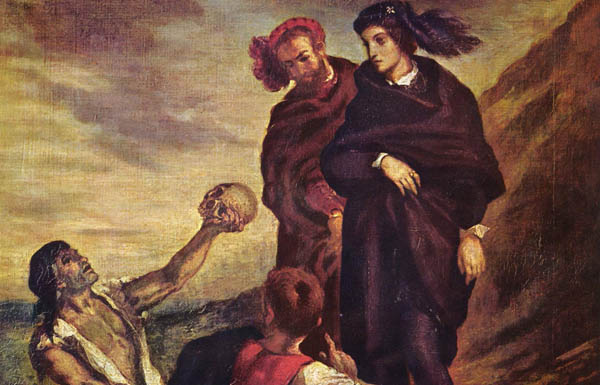
What a piece of work is a man! How noble in reason! How infinite in faculty! In form and moving how express and admirable! In action how like an angel! In apprehension how like a god! The beauty of the world! The paragon of animals! And yet, to me, what is this quintessence of dust? –Shakespeare, Hamlet
Man is the jewel of creation. To praise the reason, beauty, and power of man is, in a sense, to honor God’s creative ability and might. Man is fearfully and wonderfully made (Psalm 139). He was made a little lower than angels and is crowned with glory and honor (Psalm 8). Indeed, he is likened to a god (Psalm 82). The Lord is a master craftsman, and his highest work of earthly creation is humanity.
Now of course there is a great divide between the Divine and the human. God is beyond man’s comprehension; He alone is pure being, and He alone is God. The creature/creator distinction is not to be blurred. Nonetheless, as far as things created under the sun, man is most like God himself, being made in the very image of God. Man is like animals, sharing with them in animation, and he is like God, sharing with Him in rationality.
But what about the fall? Here human nature received a mortal wound, causing him to be bent in such a manner as to choose a lesser good, love of self, for the highest good, a love for God. Notwithstanding, the image of God remains, as does man’s ability to act in ways that conform to the rationality that comes from this image. The story gets brighter though. God in Jesus is reconciling the world back to Himself. This provides people with a new heart. One in which man’s loves are reordered and restored.
It is easy to look with disgust at the mess humans have made of the earth. As Dostoevsky observed, “People speak sometimes about the “bestial” cruelty of man, but that is terribly unjust and offensive to beasts, no animal could ever be so cruel as a man, so artfully, so artistically cruel.” Often enough history looks, as Gibbon puts it, “little more than the register of the crimes, follies, and misfortunes of mankind.” Indeed, a brief glimpse across the past reveals much that is low, debased, and downright evil. The Enlightenment project failed. Man did not prove capable of being the measure of all things, for evidently, his measurement is crooked. However, even in his misery can be seen his godlike qualities. The ability to choose a lesser good or a perversion of the good demonstrates that man is a rational animal, one who can make decisions and aim at the good, even if he chooses in a manner skewed by the sickness of sin.
Go gaze at a cathedral. Read Milton’s Paradise Lost. Walk through an old city. Look at pictures from the latest telescope, or turn your car engine on. The great thoughts and brilliant productions of art and science demonstrate the glory of man. More than that, look at the capability for love between a mother and her young child or recall great acts of religious devotion. People are not merely material; beauty, goodness, and love are not made-up constructs, they are eternal realities tied to the being of the Divine, and shed abroad on all that is wonderful here on earth. If God is the greatest of all beings, and He created mankind, calling Him good and making him lord of the earth, then it makes sense that he should demonstrate the greatness of his Maker.
God became flesh and dwelt among men. This truth recovers the dignity of being human to its full stature. Mankind was not too low for Christ to assume his nature, and it is thus that humanity is reunited with his original purpose — unity with God.
 Reflective Wanderer