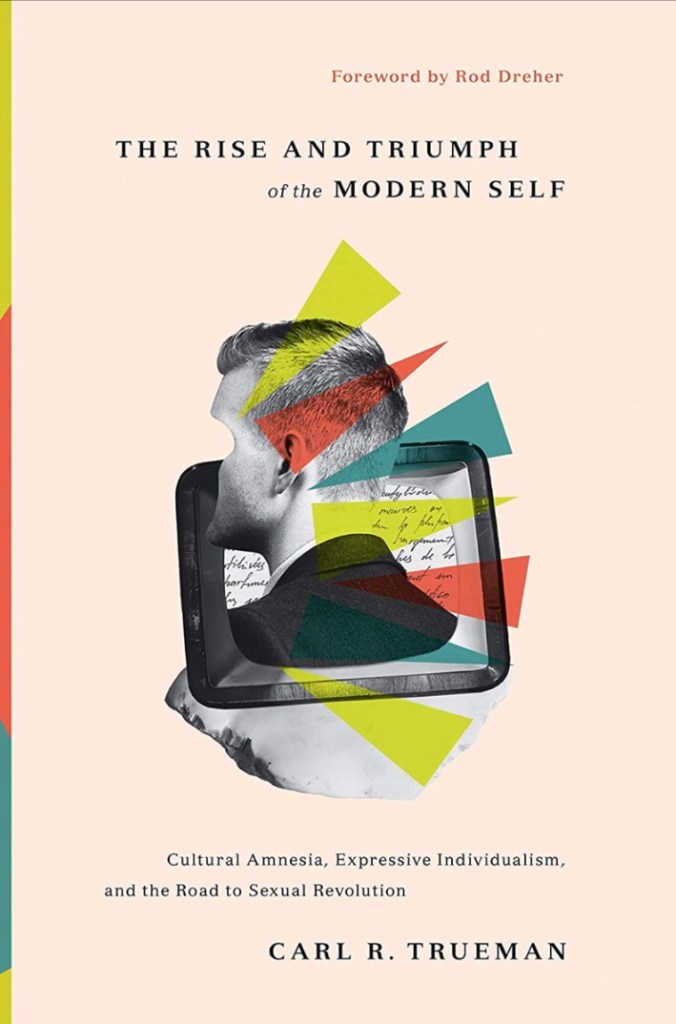
This book is about how, as a culture, saying, “I am a woman trapped inside a man’s body,” seems to make sense to many. What had to take place in a culture for that bit of nonsense, or at least that which would have seemed nonsense to most human beings across history, to be accepted, not merely in a rarefied classroom setting in a deconstructionist’s sexual ethics class, but in the culture at large. This is the question Carl Truman seeks to address in his book The Rise and Triumph of the Modern Self.
In part one, he provides some definition of terms to help the reader understand the shift that has occurred in the West. This is done largely by looking at the thoughts of three influential modern culture critics: Charles Taylor, Philip Rieff, and Alasdair MacIntyre, whose thought he relies heavily upon. A few key ideas he borrows from these writers is that of the mimesis verse poiesis from Taylor, the rise therapeutic self and death works from Rieff, and MacIntyre’s point on the artistic and personal foundation for ethics. In a mimetic or traditional culture, the individual was seen, more or less, to fit into a preconceived point of reference. From the rapid changes in technology to the Romantics emphasis on selfhood, there has been a radical shift, to where the self exists (causally) prior to the culture. Rather than fitting the self to the framework of reality, the framework of reality must be shifted to meet your own personhood. As Rieff points out, modern man has been deeply psychologized. Reality is transformed from objective points of reference, such as the polis or the church, and given to the individual, and how he or she views the world has been given primacy as a point of reference. This raises man to see himself not as possessing unity with an idea or with his community, but in terms of his own expressive individuality. Death works then are tools which are used, inadvertently or not, for tearing down the old, seemingly oppressive, order. MacIntyre is helpful too, in chronicling the shift from ethical bound by an external telos, to ethics determined on the externally free standard of emotivism. Armed with these concepts Truman begins the second part of the book, which attempts to trace the history of these concepts in Western thought.
It is in this second part where Truman’s thought becomes, necessarily, the most speculative. In tracing a history there are many possible things that could be pointed at as the cause, and yet tracing a direct effect is always a difficult thing to prove. Nevertheless he points out some strains of thinking which have had a decided influence on modern man’s social imaginary (to use a term from Taylor). From Rousseau and his placing of the emphasis on the good natural man and the evil socialized man, Truman points out in the writing of the Romantics these themes: of turning from a view of human nature which is based on external standards to one which builds on finding the authentic internal ones. He then goes after the obvious destructive works of Nietzsche, Marx, and Darwin, finding in them a destruction in the traditional metaphysical understanding of reality in favor of malleable view of reality, from the self-defining superman of Nietzsche, and economic basis for humanity in Marx, and most influential in the reduction of man into purely materialistic terms in Darwin. With these thinkers Truman lays the foundation for the mental climate ripe for the overthrowing of traditional morality in the Sexual Revolution.
In part three Truman looks at Sigmund Freud and the sexualization of man and politics. Once man become seen in predominantly sexual terms, sex becomes a weapon in the hands of the new left for political revolution. Truman dives deeply into the works of several subversive political thinkers here.
The final part, part four, looks at the triumphs of the Sexual Revolution, in three main ways. Attempting to show how the ideas in part three seeped down into the broader social imaginary. The triumph of the erotic, in playboy, public nudity, and pornography. The triumph of the therapeutic in viewing man as an expressive individual before anything else. Culminating in the triumph of the LGBTQ+ in the modern world. He mentions in passing other outlets of the triumph of the modern self in relation to things such as YouTube and Instagram, which I think is an area that needs a lot more thought.
In the conclusion Truman looks to the church, and gives a few parting thoughts to ways she can weather the current storm. To be a community, and to regain a deeper understanding of God’s natural law, while celebrating the beauty of the physical when in its proper role is key for the survival of the church in an age where the social imaginary is becoming increasingly hostile to the ethics of Christianity.
This is a needed volume, and while any attempt to trace historical causes is tricky and necessary leaves out much (and how much do great men drive culture vs. culture produce great men?), I’m thankful Truman wrote it. The book flows well, and makes use of several very helpful paradigms for looking at the modern world. Highly recommended.
 Reflective Wanderer